

Categories:
fire alarm inspection
| Published on: August 18, 2026
Under the First Aid and Occupational Health and Safety Act and Regulation, commercial workplaces in Calgary and Edmonton must maintain inspected first aid kits stocked to the standard required for their worker count and hazard class, functional eyewash stations with documented flushing records, and visible compliant signage, all with inspection records available for OHS review on request.
A workplace first aid safety inspection covers kit contents and expiry dates, the condition of the eyewash station and flushing records, signage visibility, and documentation of the last inspection date. In Canada, first aid requirements are set by provincial occupational health and safety legislation. In Alberta, the OHS Act and Regulation govern kit contents, station placement, and inspection frequency. Requirements vary by workplace size, hazard class, and number of workers.
Last month, I was doing a full compliance walkthrough at an industrial facility in Calgary. Fire alarms, sprinklers, and emergency lighting are all current. Then we got to the first aid room. The kit had supplies that expired two years prior, the eyewash station hadn’t been flushed in recorded history, and the signage was blocked by a shelving unit someone had moved in at some point. The facility manager had no idea. The fire systems were maintained. The first aid program had basically been on autopilot for years.
That’s not unusual. First aid compliance tends to get treated as someone’s secondary responsibility, maintained well when someone cares, and forgotten when staff turn over. A first-aid safety inspection fixes that by creating a documented, dated record of the actual kit and station condition, just as a fire inspection creates a record for your suppression system.
What Does a First Aid Safety Inspection Actually Cover?
A first aid safety inspection covers the physical condition and completeness of first aid kits, the function and documentation status of emergency eyewash stations, signage compliance, and overall program documentation.
It is not the same as a safety audit. It’s focused on verifiable, physical compliance items that can be checked against a standard and documented for your records. The inspection produces a written record that demonstrates your workplace met the applicable standard on a given date.
What Are the First Aid Requirements for Canadian Workplaces?
First-aid requirements in Canada are set at the provincial level. In Alberta, the OHS Act and Regulation specify kit contents, the number of trained first aiders required, and eyewash station requirements based on workplace type and hazard exposure.
Key reference points for Alberta workplaces:
- Kit contents and quantities are specified by the OHS Regulation and vary by the number of workers and hazard class
- Eye wash stations are required wherever workers may be exposed to hazardous substances, with specific placement and flushing interval requirements
- First aid kits must be inspected regularly and restocked promptly after use
- Inspection records must be maintained and available for review
Always confirm requirements with your local OHS authority, because they vary by industry sector, number of workers per shift, and workplace classification.
First Aid Safety Inspection Checklist for Canadian Commercial Workplaces
First Aid Kit Inspection
- Kit is in the designated, accessible location
- Kit is clearly labeled with a first-aid sign
- Kit is clean and free of damage or contamination
- All required contents are present per OHS Regulation for your worker count and hazard class
- No expired items in the kit (check adhesive dressings, antiseptic wipes, gloves, eye dressings separately)
- Sterile items are sealed, and packaging is intact
- Gloves are present and undamaged
- Resuscitation barrier device is present and sealed
- Kit was restocked after last use (check against log)
- Inspection date and inspector name recorded in kit log
Common Items That Expire First
| Item | Typical Shelf Life | Notes |
| Adhesive bandages | 3-5 years | Check packaging seals individually |
| Antiseptic wipes | 2-3 years | Alcohol evaporates through packaging over time |
| Sterile dressings | 3-5 years | Discard if packaging is compromised |
| Latex-free gloves | 3-5 years | Check for brittleness or discoloration |
| Eye wash solution (portable) | 1-3 years | Confirm against label; varies by manufacturer |
| CPR barrier mask | 3-5 years | Check packaging seal |
Replace expired items immediately. Keep a restocking log with the date, the station, and the name of the person who restocked.
Eye Wash Station Inspection
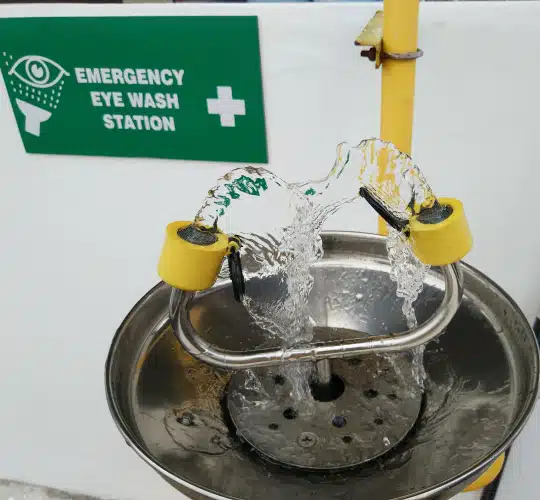
Eye wash stations are one of the most overlooked compliance items in Canadian workplaces. Under ANSI Z358.1, the station should be reachable within 10 seconds from any point where a worker could be exposed to a hazardous substance. That’s about 55 feet (or 17 meters) for a person moving at a normal pace.
- Station is within 10 seconds’ travel time from hazard exposure points
- Station is unobstructed and clearly signed
- Plumbed stations: weekly activation flushing has been performed and logged
- Portable stations: solution is within expiry date and fill level is correct
- Water temperature is tepid (16-38°C) for plumbed stations
- Dust covers are in place on nozzles
- Flushing log is current and on-site
- Flow rate meets required minimum (typically 0.4 gallons per minute for 15 minutes)
- Station is free of corrosion, scale buildup, or visible contamination
Eye Wash Station Flushing Requirements
ANSI Z358 requires plumbed eyewash stations to be activated and flushed regularly, and many workplace programs require weekly flushing for at least 3 minutes. Stagnant water in the supply line can harbor bacteria, including Legionella, in systems that don’t see regular flow. The flush needs to be logged with the date, duration, and the name of the person who performed it.
I’ve seen facilities where the log card on the station had three entries for the entire previous year. Three flushes across 52 weeks. That’s both a compliance and a practical problem.
Signage and Accessibility Checklist
- First aid kit location is marked with a recognized first aid symbol (green cross on white background)
- Eye wash station sign is visible from the hazard exposure area
- Signs are not obscured by shelving, equipment, or temporary materials
- Emergency contact information is posted at or near the first aid station
- Nearest hospital route information is posted (required in some jurisdictions)
- First aid room (if applicable) is clearly identified and accessible
Documentation and Program Records
- Written record of last kit inspection on file
- Eye wash station flush log is current
- Restocking log shows items replaced after each use
- Names and certification expiry dates of designated first aiders are on file
- First-aider certification is current (typically 3-year renewal)
- Records are available for OHS officer review on demand
How Does First Aid Inspection Connect to Emergency?
Relying on battery-powered fire safety plans and an inspection schedule that covers several adjacent fire and life-safety systems, and coordinating them under one program, is significantly more efficient than managing them separately.
Emergency lighting is the clearest overlap. If a worker is injured and power fails simultaneously, both the path to the first aid station and the exit depend on emergency lighting that operates on battery power. NFPA 101 requires an annual 90-minute battery-duration test. Monthly 30-second functionality on its own is also required.
An emergency light inspection done at the same time as your first-aid kit review identifies the relevant locations of first-aid stations; the station needs to be illuminated. The eyewash station needs to be illuminated. First-aid kits don’t cover those locations; that’s a life-safety gap that neither an inspection nor anything else would catch on its own.
Fire safety plans are the third piece. A complete fire safety plan documents emergency procedures, including where first aid stations are located and which staff members are designated as first aiders. When the plan is out of date, it typically means the first aid program information in it is also out of date. A fire safety plan consultant who understands how these systems connect can catch those gaps during a combined review.
Read more: Emergency Lighting Inspection Services at Activate Fire Safety
How Activate Fire Safety Handles First Aid Compliance in Alberta
We added first aid kit and eyewash station inspections to our service program because our clients kept asking us to. Property managers who trust us to inspect their fire alarms, sprinklers, and emergency lighting don’t want to coordinate a separate provider for first aid. It makes sense to handle it on the same visit.
Our team inspects first aid kits against OHS Regulation requirements for the facility’s worker count and hazard class, checks eyewash stations for function, flow, and flushing documentation, and communicates with communities in Alberta with a restocking recommendation. Everything goes into the same BuildingReports digital record as the fire system inspection, so you have one compliance file for the full building.
We serve commercial workplaces across Calgary, Edmonton, Airdrie, Cochrane, Okotoks, Chestermere, Sherwood Park, St. Albert, Leduc, Nisku, Spruce Grove, Fort Saskatchewan, and surrounding Alberta communities. If your first aid program has been running on autopilot, a combined inspection is usually the fastest way to find out where it actually stands.
Conclusion
A first aid safety inspection is a documented, dated review of kit contents, eyewash station condition, signage, and program records. It’s straightforward to conduct when you know what to check, and it connects directly to the emergency lighting and fire safety plan programs your building is already required to maintain. The checklist above covers the core items for Canadian commercial workplaces under Alberta OHS requirements. Confirm specifics with your local OHS authority.
If you want a certified team to handle first aid inspections alongside your building’s fire and life-safety systems, contact Activate Fire Safety for a combined compliance review.
Frequently Asked Questions About Workplace First Aid Inspections
Could workplace first aid kits be inspected in Canada?
In Alberta, first aid kits must be inspected regularly and restocked immediately after use. OHS Regulation does not specify a monthly frequency, but most compliance programs do use monthly documented visual checks, supplemented by an annual professional review. A record of each inspection, including the name of the inspector and date, shall be kept and available for review by an OHS officer.
What are the eyewash station flushing requirements for Canadian workplaces?
ANSI Z358.1 calls for regular flushing of plumbed eyewash stations, and many workplace compliance programs point of s use weekly fl for a minimum of three minutes to help prevent stagnant water and contamination in the supply line. Each flush must be logged with the date and time, and the name of the person who performed it. Portable units must have the solution replaced before the expiry date printed on the container. Placement must allow a worker to reach the station within 10 seconds from any hazard exposure point.
Do first aid inspections connect to fire safety plans to help catcherta?
Yes. Alberta Fire Code and mightHS requirements overlap at several points. A complete fire safety plan documents first-aid station locations and designated first-aider assignments. When a fire safety plan is outdated, the first-aid information in it is typically outdated as well. Reviewing both programs together during a combined compliance inspection is more efficient and catches gaps that a single-system review can miss.
Can one provider handle both first aid and fire system inspections for a commercial building?
Yes. Activate Fire Safety inspects first aid kits and eyewash stations as part of its integrated building compliance program, alongside fire alarms, sprinklers, emergency lighting, extinguishers, and hydrants. Everything is documented in a single BuildingReports digital record. Bundling first aid inspections with fire system services typically saves up to 30% compared to coordinating separate contractors for each compliance category.
About the Author: Alan Reti is the founder of Activate Fire Safety, established in Calgary on August 4, 2004. With seven years in construction and 20+ years in fire protection, he has inspected commercial and industrial properties across Calgary, Edmonton, and Alberta.


