


Categories:
Blog
| Published on: August 14, 2026
Under NFPA 25, ULC S536, and the Alberta Fire Code, commercial warehouses and distribution centers in Calgary and Edmonton must maintain seven fire protection systems on separate inspection schedules: sprinklers, fire alarms, extinguishers, emergency lighting, hydrants, fire pumps, and exit signs. No single annual inspection covers all seven. Each system has its own governing standard and documentation requirements.
Warehouses and distribution centers in Canada must maintain fire protection systems across multiple categories—automatic sprinklers, fire alarms, extinguishers, emergency lighting, hydrants, and fire pumps—each on its own inspection schedule in accordance with NFPA standards and the applicable provincial fire code.
This guide covers what each system requires, the applicable inspection intervals, and how Alberta warehouse operators can manage compliance without coordinating four different contractors.
A few years ago, I walked into a large distribution center outside Calgary for an initial compliance review. The property manager handed me a folder. It had an alarm inspection from one contractor, a sprinkler tag from another, an extinguisher sticker from a third, and no record at all for the fire pump or emergency lighting. Four contractors, four schedules, four sets of documentation, and still two systems completely undocumented. That’s not a safety program. That’s paperwork held together with hope.
Fire protection services in Canada for warehouse facilities are more complex than for most building types because of the combination of high-rack storage, large open floor areas, heavy equipment traffic, and variable occupancy. Getting the compliance program right from the start saves significant time, money, and exposure down the line.
What Fire Protection Systems Does a Canadian Warehouse Require?
Warehouses in Canada require a combination of active and passive fire protection systems. The specific configuration depends on building size, occupancy classification, storage type, and local building and fire code requirements.
Most commercial warehouse and distribution facilities need:
- Automatic sprinkler system (wet or ESFR, depending on storage height and commodity)
- Fire alarm system with initiating devices, notification appliances, and monitoring
- Portable fire extinguishers sized and placed to NFPA 10 requirements
- Emergency lighting with battery backup capable of 90-minute duration
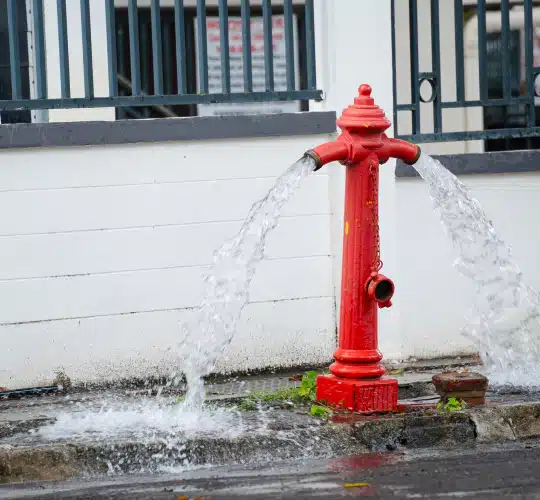
- Fire hydrants and hose connections on the property perimeter
- Fire pump (where municipal supply pressure is insufficient to meet system demand)
- Exit signs with illumination backup
Always confirm the specific system requirements for your facility with your local AHJ, because changes to storage configuration, rack height additions, and occupancy reclassifications can trigger upgraded system requirements.
Warehouse Fire Protection Compliance Checklist
| System | Governing Standard | Inspection Interval | Notes |
| Automatic sprinkler system | NFPA 25 | Weekly/monthly (gauges, valves), quarterly (waterflow alarms), annual (full), 5-year (flow test) | Dry/pre-action systems require annual trip test |
| Fire alarm system | ULC S536 (Canada) / NFPA 72 | Semi-annual or annual, depending on system and AHJ | Full device test required; monitoring verified |
| Portable fire extinguishers | NFPA 10 / Alberta Fire Code | Monthly visual (in-house), annual professional maintenance | Hydrostatic test: 12 years (ABC dry chemical), 5 years (CO2, wet chemical) |
| Emergency lighting | NFPA 101 | Monthly (30-second test), annual (90-minute full-duration test) | Replace battery packs that fail the duration test |
| Fire hydrants (private) | NFPA 25 | Annual inspection, flow test per NFPA 291 schedule | Confirm AHJ requirements for hydrant ownership |
| Fire pump | NFPA 25 | Weekly (no-flow churn test), annual (full flow performance test) | Flow test documents pump curve vs. rated output |
| Exit signs | NFPA 101 | Monthly visual, annual function test | Battery backup duration verified annually |
Requirements vary by province, building classification, and AHJ. This table is general guidance only.
What Does an Annual Fire System Inspection Cover in a Warehouse?
An annual fire system inspection for a warehouse is not a single inspection. It’s several inspections happening on a coordinated schedule. Sprinklers, alarms, emergency lighting, extinguishers, and hydrants all have annual components, but they’re governed by separate standards, and each requires its own documentation.
The practical problem this creates is contractor overlap. When four different companies each build “their” system, nobody looks at how the systems interact. The alarm panel is supposed to supervise the sprinkler control valves. The fire pump room needs emergency lighting. The hydrant flow data needs to match the sprinkler system hydraulic calculations.
Activate Fire Safety handles all of that on one coordinated visit, and every finding goes into a single BuildingReports file. One property manager, one schedule, one compliance record.
What Are the Fire Pump Inspection Requirements for Warehouses?
An annual fire pump inspection under NFPA 25 involves running the pump at full flow and recording the measured output against the pump’s rated performance curve. This is the test that catches a pump that runs but can’t deliver rated pressure and flow simultaneously.
Weekly no-flow churn tests keep the pump exercised between annual inspections. These are often assigned to building staff, but they need to be logged. An undocumented churn test is equivalent to a no-churn test during an AHJ review.
I find deteriorated pump packing, failed pressure gauges, and inoperative automatic transfer switches more often than I find outright pump failures. The components surrounding the pump are where the problems accumulate. The annual full-flow test puts everything under load at once, which is the only reliable way to catch marginal performance before it becomes a failure under fire conditions.
What’s Included in a Full Fire Pump Inspection
During a proper annual inspection, we check:
- Pump room conditions and clearances
- Driver inspection (electric motor or diesel)
- Controller function and transfer switch operation
- Pressure gauge calibration
- Packing gland condition
- Suction and discharge valve position and supervision
- Full flow test with measured GPM and PSI at multiple points on the pump curve
- Jockey pump function and pressure settings
The test results are compared against the pump nameplate data. Any shortfall in performance gets documented with corrective action notes.
Do Warehouses Need a Fire Safety Plan in Canada?
Yes, most jurisdictions in Canada require a fire safety plan for commercial and industrial occupancies above a certain size. In Alberta, the Alberta Fire Code sets out fire safety plan requirements, including evacuation procedures, staff responsibilities, system locations, and emergency contact information.
A fire safety plan is a living document. It needs to reflect the current building layout, current occupancy, and current system configuration. When a warehouse adds rack storage that triggers a sprinkler system upgrade, the fire safety plan must also be updated.
Read more: Fire Safety Plan Services at Activate Fire Safety
How Does the All-In-One Model Work for Warehouse Compliance?
Juggling four contractors for fire protection creates scheduling gaps, inconsistent documentation, and no single point of accountability when something gets missed. I built Activate’s service model around the opposite of that.
One certified team handles every system in the building on one coordinated schedule. Sprinklers, alarms, emergency lighting, extinguishers, hydrants, hose cabinets, and fire pumps. All inspected, all documented in BuildingReports with timestamped photos and deficiency tracking, all under one contract.
Our trucks are fully stocked with parts, so most deficiencies get fixed on the same visit. A failed battery pack, a damaged sprinkler head, a corroded extinguisher valve. If it’s a common deficiency and we have the part on the truck, it’s fixed before we leave. For warehouse operators, that means fewer open deficiencies sitting on your inspection report when your insurer asks for documentation.
The consolidated approach typically saves warehouse owners up to 30% compared to hiring separate contractors for each system. We serve commercial and industrial warehouse facilities across Calgary, Edmonton, Airdrie, Cochrane, Okotoks, Chestermere, Sherwood Park, St. Albert, Leduc, Nisku, Spruce Grove, Fort Saskatchewan, and surrounding Alberta communities, and we beat competing quotes by 5%.
Conclusion
Fire protection services in Canada for warehouse and distribution facilities require a coordinated compliance program across multiple systems and multiple inspection schedules. No single annual visit covers everything. The property managers who stay consistently compliant are those who’ve consolidated their fire protection under a single provider and a single documented schedule.
If you’re running a warehouse or distribution facility in Alberta and you’re not confident your compliance program covers every system at the right interval, start with a walk-through assessment. We’ll identify the gaps and put together a coordinated schedule that covers the full building.
Contact Activate Fire Safety for a no-obligation quote.
Frequently Asked Questions About Warehouse Fire Protection in Canada
What fire protection systems are required in a Canadian warehouse?
Most commercial warehouses in Canada require automatic sprinklers, a monitored fire alarm system, portable extinguishers, emergency lighting with a 90-minute battery backup, fire hydrants, and exit signs. Facilities with insufficient municipal water pressure also need a fire pump. Specific requirements depend on building size, storage type, and your local AHJ.
How often does a warehouse fire pump need to be inspected in Canada?
Under NFPA 25, fire pumps require weekly no-flow churn tests (typically performed by building staff and logged) and an annual full-flow performance test by a qualified technician. The annual test records pump output against the rated performance curve. Any shortfall in pressure or flow is flagged as a deficiency requiring corrective action.
Do warehouse operators need a fire safety plan in Alberta?
Most commercial warehouses in Canada require automatic sprinklers, a monitored fire alarm system, portable extinguishers, emergency lighting with a 90-minute battery backup, fire hydrants, and exit signs. Facilities with insufficient municipal water pressure also need a fire pump. Specific requirements depend on building size, storage type, and your local AHJ.
What's the benefit of using one fire protection contractor for a warehouse?
Consolidating fire protection under one certified provider eliminates scheduling gaps between contractors, produces a single integrated compliance record, and typically saves up to 30% compared to hiring separate trades for each system. A single provider also ensures that inter-system dependencies (alarm supervision of sprinkler valves, emergency lighting in pump rooms) are checked as a unified program.
About the Author: Alan Reti is the founder of Activate Fire Safety, established in Calgary on August 4, 2004. With seven years in construction and 20+ years in fire protection, he has inspected commercial and industrial properties across Calgary, Edmonton, and Alberta.


