

Categories:
fire alarm inspection
| Published on: September 29, 2026
Quick Answer: Fire alarm inspection is a hands-on, device-by-device test carried out by a certified technician in accordance with ULC S536. Fire alarm monitoring is a subscription service in which a central station receives and responds to signals around the clock. Monitoring proves your panel can transmit. Inspection proves the devices behind it still work. Alberta commercial buildings need both.
Table of Contents
- What Does a Fire Alarm Inspection Actually Cover?
- What Does Fire Alarm Monitoring Cover?
- The Most Common Deficiencies Found During Inspection
- Combining First Aid and Emergency Lighting Checks
- Do Fire Hydrant Testing Services Connect to Alarm Compliance?
- How Activate Handles Fire Alarm Inspection in Calgary and Edmonton
- Conclusion
- FAQs
A monitoring renewal invoice looks very much like a compliance document. It carries a date, a panel address, an account number, and a dollar figure. What it does not carry is any evidence that the smoke detectors in your building still work.
That single gap costs Alberta property managers more money than almost any other misunderstanding in this trade. Monitoring and inspection get filed in the same mental folder, so paying for one feels like it covers the other. It does not, and the gap tends to surface at the worst possible moment – during an AHJ review, or in the middle of an insurance claim.
So here is the distinction, drawn as plainly as I can draw it.
What Does a Fire Alarm Inspection Actually Cover?
A fire alarm inspection under ULC S536 requires a certified technician to physically test every initiating device, every notification appliance, and the central station communication pathway on a documented schedule. The output is a report listing the number of devices tested, pass/fail results, and every deficiency found.
This is not a walkthrough with a clipboard. Smoke detectors are tested with aerosol. Heat detectors are tested with a heat source. Pull stations are physically activated, one by one. Horns and strobes are verified for correct output. The panel itself is tested for zone response, trouble signal behaviour, and supervisory function.
For the full regulatory picture, our guide to fire alarm system inspection requirements in Canada under ULC sets out where these obligations come from. If the terminology on your service agreement is unclear, fire alarm testing versus fire alarm maintenance explains what each line item actually buys you.
What ULC S536 Requires by Frequency
| Inspection Element | Required Interval | Notes |
|---|---|---|
| Visual inspection of all devices | Annual minimum | More frequently if the AHJ requires |
| Smoke detector functional test | Annual | 100% of devices tested |
| Heat detector functional test | Annual | 100% of devices tested |
| Manual pull station test | Annual | Each device activated |
| Horn and strobe output verification | Annual | Output confirmed per device |
| Central station signal test | Annual | Transmission confirmed to the monitoring company |
| Battery load test | Annual | Under a calculated load condition |
| Control panel function | Annual | Zone isolation, trouble, alarm, and supervisory |
| Duct detector test | Annual | Each device tested in place |
Requirements vary by system type, building occupancy, and local AHJ. Confirm your specific inspection scope with a certified fire alarm technician.
What Does Fire Alarm Monitoring Cover?
Fire alarm monitoring is a subscription service connecting your alarm panel to a licensed central monitoring station. When an alarm or supervisory signal transmits, the station contacts the fire department and your building’s designated contacts. That is a genuinely valuable service and I would not advise anyone to drop it.
What it does not do is inspect your devices or your batteries. It cannot tell you whether your smoke detectors remain within their listed service life. It confirms that your panel can send a signal and that somebody will receive it, which is a narrower claim than most renewal invoices imply.
Consider a panel with a smoke detector that has drifted so far out of sensitivity range it will never activate. The panel is healthy. The transmission path is healthy. The monitoring station will report nothing wrong because, from its perspective, nothing is wrong. An inspection catches it in about ninety seconds.
I field this question a few times a month, usually from a property manager who has just opened a monitoring renewal and assumed it also covered the annual inspection. Related confusion shows up around verification: if you have recently renovated or added devices, fire alarm verification reports in Calgary cover a third document that is distinct from both.
The Most Common Deficiencies Found During Inspection
I have been running fire system inspections across Calgary and Edmonton since 2004. The deficiencies that turn up most consistently are not dramatic failures. They are small accumulated problems, and monitoring would never catch a single one of them.
- Smoke detectors drifted outside their sensitivity range through dust accumulation
- Battery backup degraded below the required capacity for the calculated load
- Pull stations with stiff or corroded mechanisms that will not activate cleanly
- Duct detectors never tested since the day they were installed
- Central station signal tests quietly skipped in previous inspection cycles
- Strobe units with failed lenses or reduced output from aging components
None of these appear on a monitoring report. They appear on an inspection report and are fixed while the technician is still in the building with the parts on hand. Why fire alarm inspection matters more than most building owners realise goes further into what a deferred deficiency actually costs.
Left unresolved, open deficiencies have a way of escalating into formal enforcement. Our guide to Calgary Fire Department compliance orders covers what happens once that threshold is crossed.
Combining First Aid and Emergency Lighting Checks
Something property managers frequently do not realise is possible: a first aid safety inspection and an emergency light inspection do not need to be separate appointments with separate contractors.
On a full building compliance visit, we coordinate fire alarm inspection, emergency lighting testing, first aid kit inspection, and extinguisher checks in one pass. Emergency lighting in Alberta falls under the Alberta Fire Code and the National Building Code, which require annual testing confirming each unit sustains its rated duration on battery, with routine function checks in between. First aid kits require documented periodic inspection under provincial OHS requirements.
Because these sit on roughly the same annual cycle as the alarm inspection, combining them is more than a convenience. Everything lands in a single BuildingReports file against a single visit date, which is what an auditor actually wants to see.
For the details on each: what the annual emergency lighting test in Calgary involves, why passing an emergency lighting inspection is not the same as being ready, and a first aid safety inspection checklist for Canadian workplaces.
Do Fire Hydrant Testing Services Connect to Alarm Compliance?
Not directly, in the sense that they sit in different inspection categories. They do share documentation requirements, and for commercial and industrial sites they are commonly scheduled together.
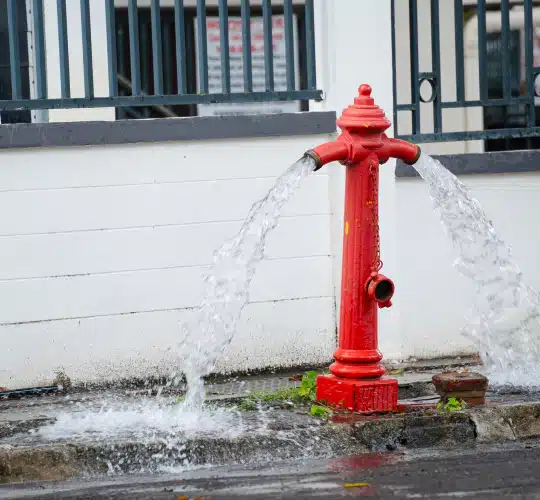
Fire hydrant testing under NFPA 25 confirms that the water supply feeding your suppression system meets specification. Where that suppression system is tied into your fire alarm panel, as it is in most commercial buildings, a flow test deficiency affects the whole compliance picture rather than one isolated corner of it.
For warehouse, industrial, and multi-tenant facilities across Calgary and Edmonton we generally schedule hydrant flow tests alongside annual sprinkler and alarm inspections, so the entire file reflects one inspection date and one renewal reminder. If responsibility for your hydrants is unclear, private fire hydrant maintenance in Calgary and Edmonton sets out who owns what, and staying compliant with Calgary hydrant regulations covers the municipal side.
How Activate Handles Fire Alarm Inspection in Calgary and Edmonton
When our team arrives for a fire alarm inspection, we work to ULC S536, test every device, and document the lot in BuildingReports with timestamped photos. Most common deficiencies are resolved during that same visit, because our trucks carry alarm components, batteries, and replacement parts. We would rather not leave open items on a report that force a second call-out.
We cover the full Calgary and Edmonton metro areas, plus Airdrie, Cochrane, Okotoks, Chestermere, Sherwood Park, St. Albert, Leduc, Nisku, Spruce Grove, and Fort Saskatchewan. The $ 100-off fire alarm inspection and maintenance offer is currently available, and we will beat any competing quote by 5%.
You can review what our fire alarm inspection and maintenance service includes, or see how it fits alongside the other eleven systems we cover. Property managers planning a full annual cycle may also find our complete fire safety inspection checklist for Calgary property managers useful, along with the ten things worth checking monthly in-house.
Conclusion
Fire system inspection services and fire alarm monitoring are complementary programs rather than substitutes. Monitoring confirms signal transmission. Inspection confirms that every device behind that signal still functions. Under ULC S536, annual inspection by a certified technician is required whether or not you hold a monitoring contract.
The documentation side matters too. A fire alarm inspection report feeds directly into your building’s fire safety plan, and an inspection schedule that has drifted out of sync with the plan is the first inconsistency a fire authority review finds.
If your last inspection report still has open deficiencies, or you are not certain when the last full device test was performed, that is where to start. Get in touch, and we will pull the file together.
Frequently Asked Questions About Fire Alarm Inspections
How often is a fire alarm inspection required in Alberta?
Under ULC S536 and the Alberta Fire Code, commercial fire alarm systems require annual inspection by a certified technician at minimum. Some AHJs require semi-annual inspection for certain occupancy types. The inspection must cover all initiating devices, notification appliances, and central station signal verification. Confirm your specific interval with your local authority having jurisdiction.
Does fire alarm monitoring replace the annual inspection requirement?
No. Monitoring confirms that your panel can transmit a signal to a central station. Inspection, carried out under ULC S536 by a certified technician, verifies that every device in the system functions correctly. Both are required, and a monitored system that has not been inspected is not a compliant system.
What happens when deficiencies are found during a fire alarm inspection?
Deficiencies are documented in the inspection report with corrective action notes. At Activate Fire Safety, common deficiencies are repaired on the same visit using parts carried on our service trucks — alarm components, batteries, and replacement devices. Clearing them on the day reduces the open-item count on your report before it reaches your insurer or AHJ.
Can fire alarm inspection be combined with other building safety inspections?
Yes, and it is more efficient that way. Activate coordinates fire alarm inspection with emergency lighting testing, extinguisher maintenance, first aid kit inspection, and hydrant testing on a single building visit, with all findings documented in one BuildingReports file. Bundling typically saves property owners up to 30% compared to hiring separate contractors for each system.
About the Author: Alan Reti is the founder of Activate Fire Safety, established in Calgary on August 4, 2004. With seven years in commercial construction and 20+ years delivering ULC-listed fire alarm inspections across Calgary, Edmonton, and Alberta, he has inspected fire alarm systems in thousands of commercial and industrial facilities


