


Categories:
Fire Safety
| Published on: November 19, 2026
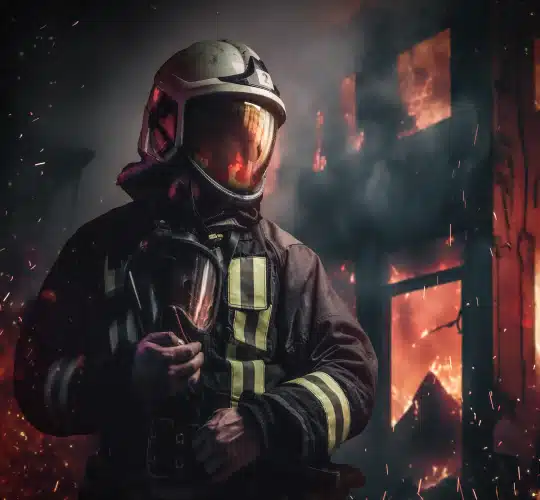
Let’s go back to a Wednesday afternoon in June in Boyle Heights. Around 2:30 p.m., firefighters were called to a cold storage warehouse near downtown. On paper, it was a warehouse fire—the sort of call crews get all the time. Within hours, it had become something completely different. Authorities told surrounding areas to shelter in place, and the FD brought in water-dropping helicopters (something they almost never do in a building fire). Inside the warehouse, steel racks stood 50 to 60 feet high, reportedly holding 85 million lbs of food. Once the roof was compromised, the fire chief said he couldn’t send any firefighters under those racks. The insulation that kept the freezers cold also trapped the smoke and heat, so you couldn’t vent the roof as you normally would. They fought the fire for over a week from the outside, ripping away walls piece by piece, using drones, and dousing it with massive volumes of water.
We don’t know what started that fire (that’s not our place to speculate). What we do know is that much of that firefight was decided before the first engine even arrived—by the racking, the roof, and what was in the building. Alberta has many large warehouses with high racking, and that’s a good starting point for thinking about what fire safety and prevention services in Alberta should be. Since 2004, we’ve done over 20,000 buildings in Calgary, Edmonton, and the surrounding areas, and that’s what really matters when the alarm goes off.
The First Few Minutes Belong to the Sprinklers
No fire department arrives the moment a fire starts, and in a sprinklered building, the minutes before the trucks arrive are critical to how big the fire will be when they do. That’s why sprinklers are at the very heart of fire safety and prevention services in Alberta.
Sprinkler inspection is covered by NFPA 25 (the standard the Alberta Fire Code refers to for water-based systems), and our team will inspect the valves, gauges, alarm devices, and heads, as well as what’s underneath them.
NFPA 13 requires at least 18″ (450mm) of clear space between the top of the stored material and a standard sprinkler head. In a warehouse that’s had a good year, stock will inevitably start to creep into that space, one pallet at a time. No one ever intends to block the sprinklers; it just happens, and a sprinkler that’s tested perfectly is useless if a wall of boxes is sitting in its spray.
Parkades and unheated loading docks are normally on dry pipe systems, and in an Alberta winter snap, any water left in low points can freeze solid. Drain those low points in the fall, and you’ll avoid a cracked pipe in January.
Early Warning Buys Everyone Time
Every minute between the fire starting and the 911 call is a minute the fire gets to grow. Our commercial fire safety services include an annual fire alarm inspection in accordance with CAN/ULC-S53,6, which includes a full test of the panel and every device on the panel (i.e., all pull stations, all detectors, all horns, and all strobes).
We also test the backup batteries, and they’re one of the most common problems we come across. A panel can sit there with a reassuring green light, while the batteries behind it are completely useless during a power cut.
Water the Firefighters Can Count On
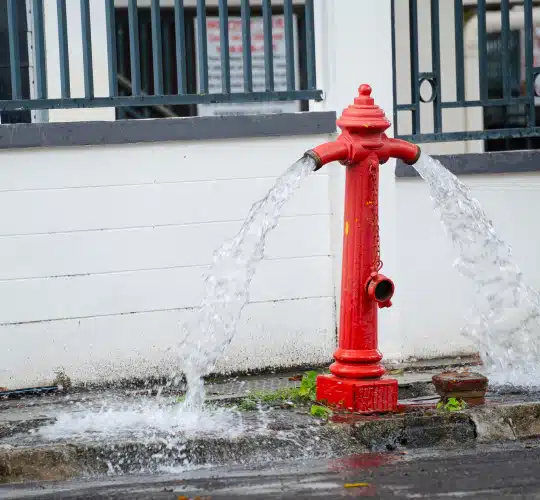
Private hydrants, fire pumps, and standpipe hose systems are all covered by NFPA 2 and 5, and our fire protection services include hydrant inspection, drafting hydrant flow testing, fire pump inspection, and fire hose testing.
A fire pump can be sitting in a clean, quiet room for months and appear perfectly serviceable and in good order. The only way to know it will work is to run it. That’s why good fire safety maintenance services never skip the test. In the winter, make sure the hydrant and the FD connection aren’t buried under a snowbank.
The Plan Firefighters Read
Most owners see the fire safety plan as nothing more than paperwork for the inspector. It’s also one of the very few documents that’s written for the people who are going to be responding to a fire. Section 2.8 of the Alberta Fire Code requires a fire safety plan for many commercial and industrial buildings, and it must include diagrams of the type, location, and operation of the building’s fire emergency systems. It must be reviewed at least annually, and a plan that simply shows last year’s layout could send a crew down the wrong corridor. That’s why we include plan reviews as part of our fire protection services.
What’s stored inside matters as well, and in Alberta that increasingly means lithium-ion batteries. By late summer, Calgary firefighters had responded to 21 lithium-ion battery fires this year (more than in all of 2025), and the Calgary Fire Department lists vapes and battery packs as common causes. Edmonton had its 20th battery fire of the year in September, with total damage for the year topping $2.1M. If you’ve got vapes, e-bikes, power tools, or spare batteries in your stockroom or warehouse, include them in your fire safety plan. The people walking through your door need to know.
The Rest of the Building
Commercial kitchens are due for a hood suppression inspection every 6 months under NFPA 17A, and part of that involves checking that each fryer and griddle is still under the nozzle intended to protect it.
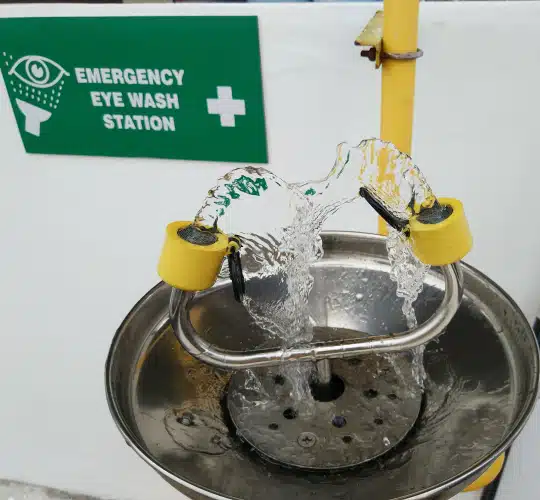
Extinguishers are serviced annually in accordance with NFPA 10, with a quick monthly check by your staff. Some units also require a six-year internal service and a hydrostatic test every 5 or 12 years (depending on the type). Emergency lighting, exit signs, first aid kits, and eyewash stations complete the list of fire protection services, and each one has its own requirements.
Fixing It Before We Leave
Our fire safety maintenance service focuses on fixing what we find on the same visit. Our trucks are stocked with the bits and pieces we use most often. We replace a broken pull station rod, service and recertify an extinguisher due for its six-year maintenance, and repair and retest a leaking backflow preventer before the technician leaves.
Everything is logged in Building Reports, with time-stamped photos of each system, so when the fire inspector or your insurer comes and asks for proof, you’ve got it.
Good fire safety maintenance services also require a bit of your help. If you’re adding racking, taking on a new tenant, doing any form of renovation, or starting to store something different, please let us know. Those are the very things that turn a straightforward building into a difficult one for the fire service.
One Team Looking at the Whole Building
Our commercial fire safety services bring all 1e-certified services under one CF-AA and UL-certified team, one schedule, and one report. For most owners, it’s about fixing issues on the spot and using one company for everything, which can save you up to 30% compared to hiring separate contractors.
To book an inspection and find out where your fire safety and prevention services in Alberta stand, contactActivate Fire Safety or call 1-866-257-2579. Our commercial fire safety services cover Calgary, Edmonton, and the surrounding areas, and we’re available 24/7 for emergency service.
If your building has a commercial kitchen, our guide to fire suppression systems in Edmonton covers the main types of systems and how each is inspected.
Frequently Asked Questions About Fire Safety and Prevention Services in Alberta
1. How often should fire sprinkler systems be inspected in Alberta?
Sprinkler systems should be inspected and maintained according to NFPA 25 and Alberta Fire Code requirements to ensure reliable operation .
2. Why is fire safety important for commercial warehouses?
Regular fire safety inspections help prevent hazards, protect inventory, and ensure fire protection systems work properly during emergencies.
3. What fire protection systems are required in commercial buildings?
Depending on the building, systems may include sprinklers, alarms, extinguishers, fire pumps, hydrants, emergency lighting, and exit signs.
4. How often should commercial fire safety equipment be inspected?
Inspection frequency varies by equipment. Fire alarms, sprinklers, extinguishers, kitchen suppression systems, and emergency lighting require regular testing and maintenance.


